Best Focus Toys for 9-Year-Olds at Home
Practical toys that help 9-year-olds settle, focus, and stay with tasks longer at home.
Snapshot
| Toy | Age | Price | Best for | Link |
|---|---|---|---|---|
| #1 ThinkFun Laser Maze | 8+ | CAD $45–$70 | Light-bending logic and spatial reasoning puzzles | Check Price |
| #2 ThinkFun Gravity Maze | 8+ | CAD $45–$70 | Co-solving logic challenges | Check Price |
| #3 ThinkFun Rush Hour | 8+ | CAD $20–$35 | Quiet logic focus and travel-friendly puzzles | Check Price |
| #4 Educational Insights Kanoodle 3D | 7+ | CAD $18–$30 | Pocket-size spatial reasoning puzzles | Check Price |
Affiliate links. Prices can change.
Nine-year-olds need focus toys that feel more like challenges, tools, or useful reset supports than toddler fidgets. At this age, a child may be able to talk clearly about homework, screens, boredom, and frustration, but still struggle to start a task, stay with a difficult step, or come down after a noisy school day.
The right focus toy can lower friction, support regulation, and make day-to-day life noticeably easier. It should not feel like a punishment or a bribe. It should help the child move from scattered to ready: a short logic challenge before homework, a quiet tactile tool during reading, or a visual reset when the afternoon is starting to unravel.
ThinkFun Laser Maze
Reliable engagement, low setup friction, and strong replay value for real family routines.
This guide focuses on toys that are practical, repeatable, and useful beyond the first week. For broader sensory support, see Best Sensory Toys for ADHD Kids. If homework is the main pressure point, pair this with Best Toys for Focus Breaks Between Homework and Best Desk Fidgets for Homework Time.
Quick Answer
For most 9-year-olds, ThinkFun Laser Maze is the best focus toy on this list because it feels like a real older-kid puzzle, has a strong science hook, and rewards careful thinking. Gravity Maze is better for kids who like marble runs and co-solving. Rush Hour and Kanoodle 3D are better for compact quiet focus. Calm Strips and textured worry stones are not full activities, but they can help a child stay regulated during reading, homework, waiting, or transitions.
If your child is already overloaded, do not start with the hardest logic puzzle. Start with a short calming tool, movement break, snack, or visual reset, then offer a challenge once their body is more ready to think.
What to Look For
Age-respectful challenge
Many 9-year-olds reject anything that feels babyish. A focus toy should offer enough challenge or usefulness to feel legitimate. Logic puzzles, spatial games, tactile tools that look discreet, and science-based activities usually land better than brightly noisy preschool toys.
Low setup friction
If the toy takes ten minutes to assemble, it will not help the after-school transition. Focus toys work best when the child can start quickly: open a case, choose one challenge card, flip one timer, rub one texture, or solve one puzzle.
A clear finish point
Nine-year-olds often do better when the end is visible. One challenge card, one puzzle, five minutes with a fidget, one reading chapter with a texture strip, or three turns before homework is more realistic than “go focus for a while.”
Quiet feedback
At home, focus support should not add more stimulation. Look for visual, tactile, or problem-solving feedback instead of constant audio. If your child gets overstimulated easily, Visual Calming Toys for Kids Who Get Overstimulated may be a better first read.
Match the toy to the state
A logic puzzle is useful when the child is ready for thinking. A tactile strip or worry stone is better when the child is restless but still needs to listen. A movement break may be better when the child is climbing furniture or melting down.
Our Top 6 Picks
ThinkFun Laser Maze
Light-bending logic and spatial reasoning puzzles
Pros
- ✓ Distinct science hook
- ✓ Compact challenge cards
- ✓ Strong older-kid puzzle value
Cons
- ✗ Button batteries
- ✗ Mostly solo play
- ✗ Too hard for younger beginners
Laser Maze is the strongest overall pick because it makes focus feel like solving a real problem. The child places mirrors and beam splitters so the laser reaches the target. That gives clear feedback: either the light path works or it does not. For many 9-year-olds, that is more motivating than another workbook-style thinking activity.
The main caution is frustration. Some children will jump into harder cards and then quit when the beam does not work. Start with easier challenges and frame mistakes as testing, not failure. Because it uses button batteries, it also needs adult awareness. Store it away from younger siblings and check the battery compartment regularly.
ThinkFun Gravity Maze
Co-solving logic challenges
Pros
- ✓ Great age fit for 9-year-olds
- ✓ Encourages planning
- ✓ Compact setup
Cons
- ✗ Can become one-kid-at-a-time
- ✗ Harder cards may need help
- ✗ Less open-ended than building sets
Gravity Maze works well for 9-year-olds who like marble runs, towers, and visible cause and effect. The child has to plan a route through the pieces, then test whether the marble reaches the target. That loop encourages prediction, revision, and persistence without looking like schoolwork.
It can also become frustrating if the child treats every wrong attempt as failure. Use language like “test run” and “what changed?” rather than “wrong.” If siblings want to join, have them alternate card reader, builder, and marble-dropper roles so one child does not take over.
ThinkFun Rush Hour
Quiet logic focus and travel-friendly puzzles
Pros
- ✓ No batteries
- ✓ Portable
- ✓ Great thinking reps
Cons
- ✗ Single-player
- ✗ Can feel hard at first
- ✗ Needs progression support
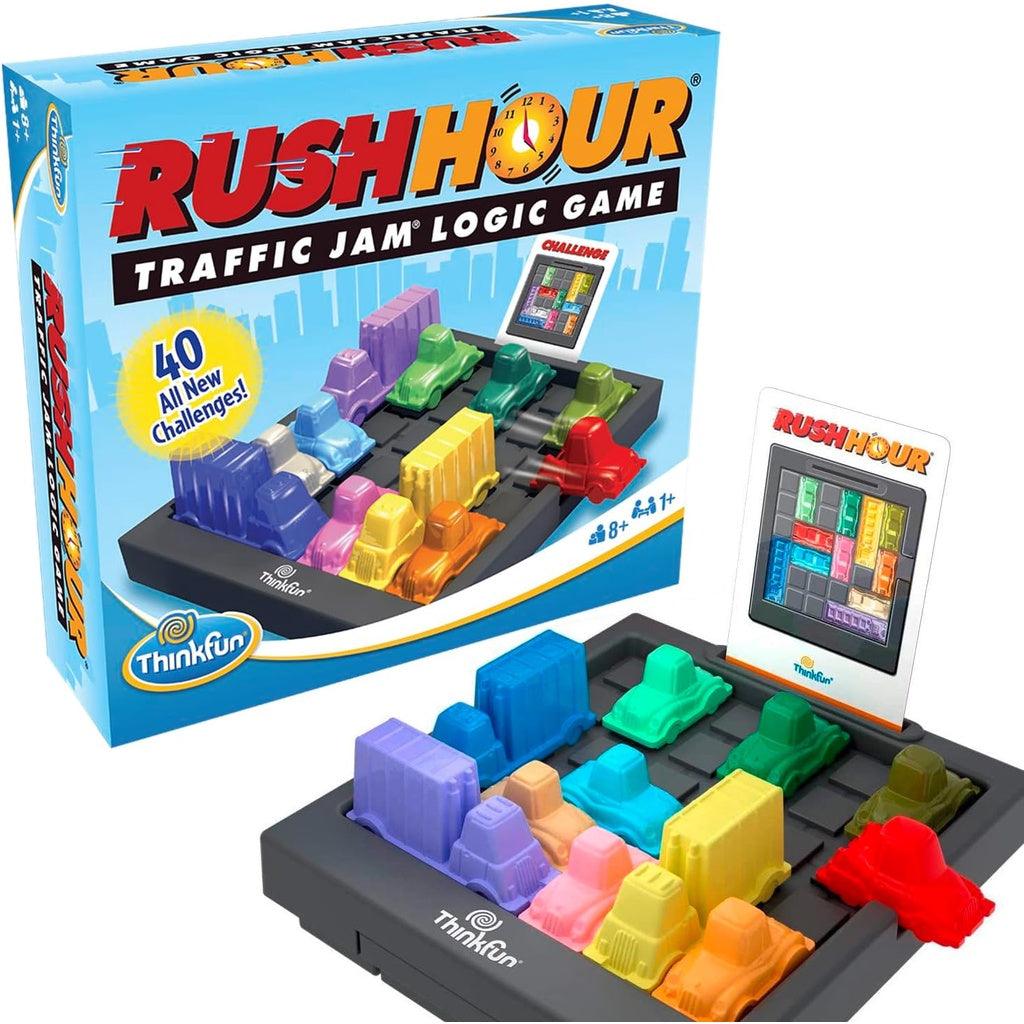
Rush Hour is a quieter, more compact focus toy. The traffic-jam puzzle gives a clear goal and a contained board, which makes it useful at the kitchen table, beside a reading chair, or during a screen-free reset. It is also easier to pack than larger logic sets.
The adult role is to prevent random sliding. Ask one focusing question: “Which car is blocking the exit first?” That prompt helps the child slow down and plan. If your child needs a slightly easier version for travel or younger siblings, Rush Hour Junior may be enough.
Pocket-size spatial reasoning puzzles
Pros
- ✓ Tiny footprint
- ✓ No setup beyond opening the case
- ✓ Many challenge levels
Cons
- ✗ Small pieces
- ✗ Mostly solo play
- ✗ Harder puzzles can frustrate
Kanoodle 3D is a good pick when you want a focus toy that can live in a desk drawer, backpack, or calm-down basket. The pieces and challenges fit in a small case, and the puzzle asks for spatial reasoning without a screen. It works especially well for short reset blocks before homework or after school.
The small pieces mean it needs a reliable storage rule. Use it at a table, tray, or desk rather than on the couch. If your child loses pieces easily, choose Rush Hour or Laser Maze instead. For travel use, see Best Road Trip Toys for 8-Year-Olds.
Silent tactile input on desks, notebooks, and devices
Pros
- ✓ Invisible in class
- ✓ No loose parts
- ✓ Great for quick regulation
Cons
- ✗ Adhesive wears over time
- ✗ Limited texture per strip
- ✗ Needs clean surfaces
Calm Strips are background support, not a main activity. For a 9-year-old who rubs sleeves, picks at objects, chews pencils, or constantly reaches for something during reading, a texture strip gives the hands a designated place to go. Put it on a notebook, desk edge, water bottle, device case, or reading folder.
They work best when the child chooses the placement. If the strip is introduced as “this will make you focus,” it may feel insulting. If it is introduced as a tool they control, it is more likely to help. For a direct comparison with a handheld option, see Calm Strips vs Marble Mesh Fidget for Classroom Focus.
Pocket-size tactile calming and transition support
Pros
- ✓ Portable
- ✓ Quiet
- ✓ Great for waiting rooms and transitions
Cons
- ✗ Easy to lose
- ✗ Not highly engaging for long sessions
- ✗ Material quality varies
Textured worry stones are useful for quiet hand input during reading, waiting, appointments, car rides, or difficult transitions. They are small enough to keep in a pocket or pencil case, and they look less toy-like than many fidgets. That matters for older kids who do not want to feel singled out.
They are not strong entertainment and they will not solve homework resistance by themselves. Think of them as a support layer. They help best when paired with a clear routine: one stone during read-aloud time, one in the homework basket, one in the travel pouch.
How to Use Focus Toys Without Creating a Battle
Use the toy before the demand
Many families introduce focus tools too late, after the child is already stuck or upset. Try using the toy before the hard thing: five minutes of Laser Maze before math, one Kanoodle card before spelling, or one tactile tool during the transition from snack to reading.
Keep the language neutral
Say “choose your reset” or “help your body get ready” instead of “use this so you behave.” The toy should feel like support, not proof that the child is doing something wrong.
Separate focus toys from rewards
If the toy is only available as a prize, it loses its job as a tool. Keep a few options in a focus basket so the child can use them as part of a routine. Rewards can still exist, but regulation tools should not require perfect behaviour first.
Protect the focus zone
A 9-year-old may need a calmer spot more than a new toy. Clear one table corner, reduce visual clutter, keep a water bottle nearby, and store only two or three focus options there. Too many choices can become another distraction.
Best Picks by Situation
For homework starts
Try Rush Hour, Kanoodle 3D, or Calm Strips. Use a short finish line: one card, one puzzle, or one chapter. The goal is to get the brain into a steadier rhythm, not extend homework by an hour.
For after-school decompression
Start with lower demand. A worry stone, Calm Strip, snack, and movement break may come before Laser Maze or Gravity Maze. If afternoons are the hardest part of the day, Best Calm-Down Toys for After School is worth reading.
For screen-free challenge
Laser Maze, Gravity Maze, Rush Hour, and Kanoodle are the best fits. They give problem-solving feedback without a tablet. Rotate them so none becomes stale.
For anxious or overstimulated kids
Use tactile and visual supports first. Calm Strips, worry stones, a liquid motion timer, or a calming corner may work better than a puzzle when the child is already overloaded.
Want better toy picks without the research rabbit hole?
Short, practical recommendations by age, need, and budget.
FAQ
Are these toys only for kids with ADHD?
No. These picks can help many kids who need better focus, calmer transitions, or lower stimulation play at home. A diagnosis can explain the pattern, but the practical question is still what helps the routine work.
Should focus toys be used during homework?
Sometimes. Silent tactile tools can help during reading or listening. Logic puzzles usually work better before or after homework because they can pull attention away from the assignment.
What if my 9-year-old says focus toys are babyish?
Start with older-looking options like Laser Maze, Rush Hour, Kanoodle, or discreet textured tools. Avoid presenting the toy as therapy unless your child already likes that language.
How many focus toys should we keep out?
Keep two or three visible: one thinking challenge, one tactile option, and one calming or movement option. Store the rest and rotate weekly so the setup stays fresh.
Related reads
- Best Sensory Toys for ADHD Kids
- Best Toys for Focus Breaks Between Homework
- Best Desk Fidgets for Homework Time
- Calm-Down Corner Toys That Actually Help
- Calm Strips vs Marble Mesh Fidget for Classroom Focus
If You Can Only Buy One
ThinkFun Laser Maze is the best single pick for many 9-year-olds because it feels age-respectful, compact, and genuinely challenging. If your child is easily frustrated or already overloaded after school, start with Calm Strips or a textured worry stone first, then add a logic puzzle once the routine is steadier.
Want better toy picks without the research rabbit hole?
Get concise recommendations by age, need, and budget.
Where to go next
By age
Best Homework Break Toys for 9-Year-Olds
Keep the recommendations age-appropriate for your kid’s stage.
By need
Best Sensory Toys for Kids with ADHD (2026)
Jump to picks focused on ADHD, sensory, and regulation support.
By budget
Best Gifts for Kids Under $25 (2026)
Compare strong options in lower price brackets before you buy.
Related Articles
Best Toys for Kids Who Rush Through Homework
Focus-break and thinking toys for kids who hurry through homework, guess quickly, or need practice slowing down.
Read more →
Best No-Mess Sensory Toys for Bedrooms
Low-mess sensory toys that can live near the bed without sand, slime, batteries, or cleanup fights.
Read more →
Calm Strips vs Marble Mesh Fidget for Classroom Focus
A quiet fidget comparison for school, homework, and kids who need discreet tactile input.
Read more →