Roller Coaster Challenge vs GraviTrax for Engineering Kids
Compare two build-and-test STEM toys for kids who like tracks, physics, and problem solving.
Snapshot
| Toy | Age | Price | Best for | Link |
|---|---|---|---|---|
| ThinkFun Roller Coaster Challenge | 6+ | CAD $45–$70 | Engineering logic through build-and-test coaster puzzles | Check Price |
| Ravensburger GraviTrax Starter Set | 8+ | CAD $55–$85 | Physics through play | Check Price |
Affiliate links. Prices can change.
ThinkFun Roller Coaster Challenge and Ravensburger GraviTrax both turn engineering into something kids can see. A track works, fails, slows down, drops the marble, or finally makes it to the finish. That visible feedback is the point.
The better choice depends on what kind of engineering play your child will actually repeat. Roller Coaster Challenge is more like a structured logic puzzle with coaster pieces. GraviTrax is more like an open-ended marble-run system with physics, trial and error, and room to invent.
This is a two-toy comparison. The goal is not to list every nearby STEM toy; it is to make the better choice between these two.
These belong together because both are screen-free engineering toys built around tracks, gravity, spatial planning, and repeat testing for similar age ranges. The real tradeoff is challenge-card structure versus bigger open-ended system building.
Quick Answer
- Choose ThinkFun Roller Coaster Challenge if your child likes puzzles, clear goals, and a contained build area.
- Choose Ravensburger GraviTrax Starter Set if your child likes open-ended systems, marble runs, and experimenting with height, speed, and layout.
- Choose Roller Coaster Challenge for a cleaner one-child logic toy.
- Choose GraviTrax for a bigger hands-on STEM project with more room to tinker.
Comparison Table
| Decision point | ThinkFun Roller Coaster Challenge | Ravensburger GraviTrax Starter Set |
|---|---|---|
| Best fit | Kids who like structured build challenges | Kids who like open-ended track systems |
| Learning style | Spatial logic, sequencing, constraint solving | Physics, cause and effect, iteration |
| First-session feel | More contained and puzzle-like | Bigger, busier, and more exploratory |
| Setup friction | Pieces need sorting, but the play space stays small | Needs floor/table space and a clear build zone |
| Parent involvement | Helpful for harder cards or piece organization | Helpful for first layouts and cleanup habits |
| Best long-term use | Challenge-card progression and quiet thinking reps | Rebuilding, testing, expanding, and inventing tracks |
The Two Picks
Engineering logic through build-and-test coaster puzzles
Pros
- ✓ Clear challenge progression
- ✓ Great cause-and-effect feedback
- ✓ Stronger novelty than another circuit kit
Cons
- ✗ Pieces need organization
- ✗ One-player-at-a-time tendency
- ✗ Harder cards may need help
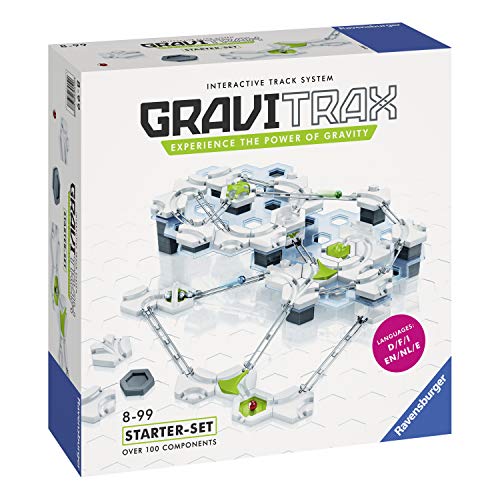
Physics through play
Pros
- ✓ Strong experimentation loop
- ✓ Visual cause/effect
- ✓ Expandable
Cons
- ✗ Needs floor/table space
- ✗ Pieces can be lost
- ✗ Best with a clear build area
What Makes These Toys Different
Roller Coaster Challenge is best understood as a puzzle game that happens to use coaster pieces. The child gets a challenge, chooses where supports and track sections go, then tests whether the car can complete the path. The engineering lesson is about constraints: the pieces must fit, the path must connect, and the coaster has to work inside the problem the card gives them.
That structure is useful for kids who like knowing what “done” means. They are not staring at a pile of pieces wondering what to build. They have a problem to solve and a result they can check.
GraviTrax is more open. Kids build a marble track, test it, change the elevation, add turns, adjust spacing, and try again. The lesson is less about solving one prescribed puzzle and more about building a system that behaves the way they predicted. If the marble loses speed, overshoots, or gets stuck, the child can often see why.
The practical difference is focus. Roller Coaster Challenge says, “Can you solve this coaster puzzle?” GraviTrax says, “What kind of track can you make work?”
Setup and Parent Involvement
Roller Coaster Challenge is easier to contain. It still has pieces that need organization, but the play usually stays on a table. The first session goes best when an adult helps the child learn how to read the challenge cards and put pieces away by type. After that, many kids can work through easier cards independently.
The harder cards may need emotional coaching. A child might build something that looks close but does not run correctly. That is the useful moment, but it can feel like failure. A parent can help by asking, “Where does it stop?” instead of immediately fixing it.
GraviTrax needs more space and more cleanup discipline. It is not a tiny travel toy. It works best when there is a table, floor mat, or clear corner where pieces can stay visible while the child experiments. If every session begins with missing pieces and a messy pile, the toy becomes less inviting.
Parent help is most useful at the beginning: start small, build one working track, then add complexity. Kids who start with a giant dream layout often hit frustration before they understand the pieces.
Which One Builds Better Engineering Thinking?
Roller Coaster Challenge is stronger for structured spatial reasoning. Kids have to understand height, path order, orientation, and how separate pieces connect into one working route. It also teaches a useful design habit: test the specific place where the system fails.
That makes it a good fit for kids who like logic games, puzzles, mazes, and step-by-step challenges. It can also work well for children who want engineering play but get overwhelmed by too many open-ended choices.
GraviTrax is stronger for physics experimentation. Kids see speed, gravity, momentum, and cause and effect in a more flexible way. It encourages “what if?” thinking: what if the track is higher, what if the turn is sharper, what if the marble starts from a different point?
That makes it a better fit for kids who like tinkering, building big layouts, or changing a system repeatedly. It may also be more exciting for siblings because one child can build while another tests, times, or suggests changes.
Frustration Risk
Roller Coaster Challenge frustration usually comes from being almost right. The coaster looks finished, but the car still does not make it. That can be hard for kids who expect a quick win. The fix is to start below the child’s age level and let them build confidence with easier cards before jumping ahead.
GraviTrax frustration usually comes from scale. Kids build too much too soon, the marble flies off, or the whole setup gets bumped. The fix is to define a tiny goal: one launch, one drop, one turn, one finish. Once that works, add one more feature.
If your child likes a clear answer, Roller Coaster Challenge is safer. If your child enjoys tinkering through messy trial and error, GraviTrax is more rewarding.
Replay Value Over Time
Roller Coaster Challenge has replay value because the challenge sequence gives the toy a path. It is easy to pull out for one or two puzzles, then put away. The risk is that it can feel like a solo puzzle rather than a shared project, especially once the child has worked through favourite cards.
GraviTrax has replay value because the system can grow and change. The starter set can become a weekend build, a sibling challenge, or an ongoing “make the marble do this” project. The risk is storage and setup friction. If the pieces are not easy to access, it may sit in the box.
For short, repeatable thinking sessions, Roller Coaster Challenge is the cleaner pick. For long, open-ended STEM play, GraviTrax has more ceiling.
Storage, Cleanup, and Space
Roller Coaster Challenge is easier for apartments, shared tables, and families who need toys to reset quickly. A small bin or labelled bag system helps a lot because the play depends on finding the right support or track piece quickly.
GraviTrax needs a home. It is best when the pieces can live in a dedicated container and the child has permission to spread out for a while. If your house does not have that kind of play space, choose the more contained toy first.
Where to Go Next
If GraviTrax sounds right but you want to compare it with a quieter logic puzzle, read GraviTrax vs Rush Hour for problem-solving kids. For more hands-on STEM ideas, see STEM toys for kids who hate worksheets. If your child prefers robotics and coding, start with smart toys for kids new to coding.
Related articles: GraviTrax vs Rush Hour | STEM toys for kids who hate worksheets | smart toys for kids new to coding
Final Recommendation
Start with ThinkFun Roller Coaster Challenge if your child likes structured puzzles, needs a clear challenge path, or does best with a contained table toy. It gives engineering practice without requiring a huge build area.
Choose Ravensburger GraviTrax Starter Set if your child loves building, tinkering, and testing a physical system repeatedly. It asks more of your space and cleanup routine, but it has the stronger open-ended engineering feel.
FAQ
Which one is easier to start with?
Roller Coaster Challenge is easier to start because the challenge cards give the child a clear job. GraviTrax is more exciting visually, but the first session can sprawl if you do not start with a small build.
Which one has more long-term depth?
GraviTrax has more open-ended depth because kids can keep inventing layouts and expanding the system. Roller Coaster Challenge has strong puzzle depth, but it stays within the challenge-card format.
Which one is better for a 6-year-old?
Roller Coaster Challenge is usually the better first fit for a 6-year-old because it is rated younger and more contained. GraviTrax is better for older kids or younger builders who already handle multi-piece construction calmly.
Can siblings play together?
GraviTrax is better for sibling play because one child can build while another tests or suggests changes. Roller Coaster Challenge can be shared, but it naturally leans toward one child solving one challenge at a time.
Should I buy both?
Not at first. Choose Roller Coaster Challenge for structured engineering puzzles. Choose GraviTrax for open-ended physics builds. Add the other later if your child shows sustained interest in track-based STEM play.
Want better toy picks without the research rabbit hole?
Get concise recommendations by age, need, and budget.
Where to go next
By age
Best Toys for 4-Year-Olds (Learning Through Play) (2026)
Keep the recommendations age-appropriate for your kid’s stage.
By need
Gifts for Neurodivergent Kids: A Parent's Guide (2026)
Jump to picks focused on ADHD, sensory, and regulation support.
By budget
Best Gifts for Kids Under $25 (2026)
Compare strong options in lower price brackets before you buy.
Related Articles

Best Screen-Free Math Toys for Preschoolers
Hands-on math toys that help preschoolers practise counting, comparison, patterns, and early problem solving without screens.
Read more →
Best Quiet Logic Toys for Apartments
Low-noise logic toys for apartment play, quiet rooms, and families who need thinking practice without chaos.
Read more →
Monster Scale vs Mental Blox for Early Logic
A comparison for families choosing between early math comparison play and spatial logic challenges.
Read more →