Best Toys for 4-Year-Olds (Learning Through Play) (2026)
12 genuinely useful toys for 4-year-olds that build language, motor skills, creativity, and early STEM without feeling like homework.
Snapshot
| Toy | Age | Price | Best for | Link |
|---|---|---|---|---|
| Magna-Tiles Classic 100-Piece | 3+ | CAD $120–$160 | Best all-around toy for 4-year-olds | Check Price |
| LEGO DUPLO Town Deluxe Brick Box | 1.5+ | CAD $70–$95 | Fine motor + imaginative scene building | Check Price |
| Osmo Little Genius Starter Kit | 3-5 | CAD $100–$140 | Guided learning with movement and touch | Check Price |
| Kinetic Sand Sandbox Set | 3+ | CAD $30–$45 | Sensory play and calming transitions | Check Price |
Affiliate links. Prices can change.
Age four is peak curiosity.
They ask "why" all day, narrate imaginary emergencies, build towers just to test the crash, and suddenly want to do everything "by myself." The best toys for 4-year-olds respect that mix: big imagination, growing coordination, short patience, and a very real need to move.
Magna-Tiles Classic (100-Piece Set)
Open-ended, no rules required, and grows with your child. Great for spatial skills, storytelling, and cooperative play.
The best toys at this age are simple enough to use independently, but open-ended enough to stay fun for years. A toy that only performs one trick usually fades fast. A toy that lets a 4-year-old build, pretend, sort, explain, knock down, and try again has a much better chance of becoming a daily-use favourite.
Quick Answer
If you are buying for a 4-year-old, prioritize open-ended building, pretend play, sensory play, and screen-free language support. Magna-Tiles, DUPLO, kinetic sand, wooden blocks, pretend-play props, and an audio player cover more developmental ground than most branded "learning" toys.
For slightly older creative kids, see best creative toys for 5-year-olds. If your 4-year-old gets restless quickly, best toys for kids who get bored easily has more novelty-resistant picks.
What matters most at age 4
A good 4-year-old toy does not need to teach letters out loud. It should invite useful play:
- Open-ended play instead of a single correct answer.
- Hands-on building for spatial reasoning, planning, and fine motor control.
- Pretend scenarios for language, social practice, and emotional processing.
- Short setup, long play because complicated parent assembly lowers real-world use.
- Durability because four-year-olds test hinges, magnets, lids, buttons, and patience.
This is also the age where toys need to survive mood swings. A child may be deeply focused one day and silly the next. Open-ended toys handle that better because there is no one "right" way to play.
Top picks
Best all-around toy for 4-year-olds
Pros
- ✓ Infinite builds
- ✓ Strong independent play
- ✓ Great for sibling play
Cons
- ✗ Pricey
- ✗ Need big set for best value
- ✗ Magnets can weaken over years
If you want one toy that gets used daily, this is it. Magna-Tiles let a 4-year-old build houses, garages, animal pens, rockets, castles, roads, and pretend shops without needing adult instructions. The learning is real, but it happens through trial and repair: Why did the roof collapse? What shape makes the wall stronger? How do we make room for the dinosaur?
The 100-piece set matters because small magnetic-tile sets often disappoint. Four-year-olds build big, then rebuild bigger. If siblings will play too, a larger set reduces arguments and makes cooperative play more likely.
Fine motor + imaginative scene building
Pros
- ✓ Easy to handle
- ✓ Huge creative range
- ✓ Very durable
Cons
- ✗ Can feel repetitive with smaller sets
- ✗ Storage needed
DUPLO at age 4 is still a win, especially for kids who enjoy building worlds. The pieces are chunky enough to avoid frustration but structured enough to support more intentional designs than toddler stacking. Kids can make homes, vehicles, clinics, farms, restaurants, and elaborate "rescue" scenes.
DUPLO is also excellent for language. Ask your child what each character is doing, what problem happened, and what happens next. That turns simple brick play into storytelling without turning it into a lesson.
Guided learning with movement and touch
Pros
- ✓ Interactive without passive screen time
- ✓ Excellent literacy/pre-math exposure
- ✓ Engaging characters
Cons
- ✗ Requires iPad
- ✗ Pieces can get lost
- ✗ Best with parent setup first
One of the better "smart" options if you already own an iPad. Osmo works because the child is still moving physical pieces, not just tapping a screen. That makes it more active than many preschool apps.
The catch is setup. This is not the toy to hand over during a chaotic dinner rush the first time. Open it with your child, sort the pieces, learn the flow, then decide when it fits. If screens tend to dysregulate your child, keep sessions short and end before frustration appears. For more non-screen options, start with screen-free toys for kids.
Sensory play and calming transitions
Pros
- ✓ Mess-light sensory play
- ✓ Very calming
- ✓ Easy reset
Cons
- ✗ Can still get everywhere
- ✗ Dries over time if not sealed
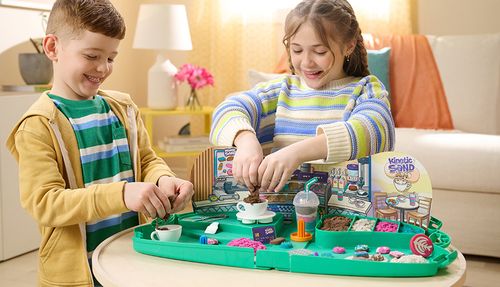
Fantastic for post-daycare decompression. Kinetic sand gives busy hands something slow and satisfying to do after a loud day. It also builds hand strength, bilateral coordination, pretend play, and early design thinking when kids make roads, cakes, mountains, or construction sites.
It is not mess-free, but it is more manageable than slime, beads, or open-ended water play. Use a tray, set a clear boundary, and store it in a sealed bin. If sensory play is the main goal, compare with best sensory toys for toddlers for younger-child-safe options.
Classic stacking, balance, and open-ended play
Pros
- ✓ Simple and timeless
- ✓ Strong motor skill work
- ✓ Great value
Cons
- ✗ No novelty factor
- ✗ Needs floor space
Old-school for a reason. Blocks still work. They teach balance, symmetry, patience, sorting, counting, and cause-and-effect without batteries or instructions. They are also one of the easiest toys for adults to join briefly without taking over.
The main downside is storage and noise. Wooden blocks need floor space, and towers fall loudly. If you live in an apartment or have a noise-sensitive household, add a rug or play mat. For lower-volume options, see best quiet toys for apartments.
Creativity + hand strength
Pros
- ✓ Cheap and engaging
- ✓ Great for hand control
- ✓ Pretend play booster
Cons
- ✗ Dries out if left open
- ✗ Cleanup required
Easy win, especially if your child likes pretend cooking. Play-Doh builds hand strength and finger control in a way worksheets cannot. Rolling, pinching, flattening, cutting, and shaping all support pre-writing muscles.
The best use is not "make the exact picture on the box." It is running a pretend bakery, making food for stuffed animals, building monster faces, or creating a grocery shop. Keep colours limited if mixed Play-Doh bothers you. If cleanup is the dealbreaker, use it only at a table with a placemat and a clear closing routine.
Screen-free stories and independent listening
Pros
- ✓ No ads, no algorithm
- ✓ Builds listening stamina
- ✓ Travel friendly
Cons
- ✗ Cards are extra
- ✗ Initial setup needed
Great for quiet time, winding down, and independent listening. Four-year-olds often want stories but cannot read alone yet. An audio player gives them a way to revisit favourite stories without a screen or autoplay algorithm.
It is especially useful for rest time, car rides, and bedtime. The value depends on whether your child likes listening without visuals. Start with familiar stories or songs rather than assuming a brand-new audiobook will hold attention immediately.
Early number sense and social play
Pros
- ✓ Natural counting practice
- ✓ Role-play friendly
- ✓ Durable
Cons
- ✗ Chunky storage footprint
- ✗ Sound effects may annoy adults
Math practice disguised as shopkeeper roleplay. A cash register gives 4-year-olds a reason to count, sort, take turns, name objects, negotiate prices, and act out everyday social scripts.
It works best when paired with pretend groceries, blocks, stuffed animals, or homemade price tags. You do not need to drill addition. Just ask, "How many apples?" or "What does the dinosaur want to buy?" That is enough.
What to skip at this age
Skip overly complex STEM kits with heavy instructions. Four-year-olds can absolutely explore early STEM, but kits that require precise assembly often become parent projects. Also skip toys with one trick and no replay value, tiny-piece sets that frustrate more than teach, and anything marketed as educational but built around passive watching.
A good rule: if the toy needs an adult to constantly explain what to do, it may be too old. If the toy invites the child to start and then expands through conversation, it is probably a better fit.
Best combo if you're buying just 3
1. Magna-Tiles for building, spatial reasoning, and imagination.
2. Kinetic Sand for sensory regulation and calm hands-on play.
3. Yoto Mini for language, quiet time, and screen-free independence.
That gives you movement, calm, creativity, and language without overloading your shelves. If your child already owns one of those lanes, replace it with DUPLO, wooden blocks, or pretend-play props.
Want better toy picks without the research rabbit hole?
Short, practical recommendations by age, need, and budget.
FAQ
Are educational toys better than regular toys?
Only if the child actually uses them. A "less educational" toy played with every day beats a perfect learning toy that sits untouched. At age 4, building, pretending, sorting, listening, and explaining are all educational.
How many toys should a 4-year-old have out at once?
Fewer than most homes currently have. Toy rotation works. Keep 6-10 high-use toys accessible and rotate weekly. Too many visible toys can make play shorter because the child keeps switching.
Is screen-based learning okay at 4?
In small doses, yes. Prioritize interactive over passive. If a screen toy turns your child into a zombie, starts fights when it ends, or replaces hands-on play, it is not helping.
What toy has the best long-term value?
Open-ended building toys usually last longest: magnetic tiles, DUPLO, wooden blocks, and pretend-play systems. They adapt as your child moves from simple stacking to stories, rules, and more complex designs.
Bottom line
For 4-year-olds, learning through play should still feel like play. Choose toys that let your child build, narrate, test, move, calm down, and try again.
If a toy creates real play without constant adult management, that is the win.
Related guides: Best creative toys for 5-year-olds | Best toys for kids who get bored easily | Screen-free toys for kids | Best quiet toys for apartments
Want better toy picks without the research rabbit hole?
Get concise recommendations by age, need, and budget.
Where to go next
By age
Best Screen-Free Weekend Toys for 5-Year-Olds
Keep the recommendations age-appropriate for your kid’s stage.
By need
Gifts for Neurodivergent Kids: A Parent's Guide (2026)
Jump to picks focused on ADHD, sensory, and regulation support.
By budget
Best Gifts for Kids Under $25 (2026)
Compare strong options in lower price brackets before you buy.
Related Articles
Mental Blox vs Rush Hour Junior for Logic Skills
Compare two low-tech logic toys for kids who need more thinking reps without screens.
Read more →
Monster Scale vs Numberblocks MathLink Cubes for Preschool Math
Compare two hands-on math toys for early counting, number sense, and quiet learning play.
Read more →
Best Calm Waiting-Room Toys for Kids
Small quiet toys for appointments, restaurants, waiting rooms, and other moments where kids need help staying regulated.
Read more →