Best Road Trip Toys for 8-Year-Olds
Travel-friendly toys for 8-year-olds that reduce boredom and meltdowns during long drives.
Snapshot
| Toy | Age | Price | Best for | Link |
|---|---|---|---|---|
| #1 Educational Insights Kanoodle 3D | 7+ | CAD $18–$30 | Pocket-size spatial reasoning puzzles | Check Price |
| #2 ThinkFun Rush Hour Junior | 5+ | CAD $25–$45 | Fast-start traffic-jam logic puzzles | Check Price |
| #3 Calm Strips (Textured Stickers) | 6+ | CAD $6–$13 | Silent tactile input on desks, notebooks, and devices | Check Price |
| #4 Melissa & Doug Reusable Sticker Pad | 3+ | CAD $8–$17 | Portable quiet play for travel and waiting rooms | Check Price |
Affiliate links. Prices can change.
Eight-year-olds can handle more challenge on a road trip than younger kids, but they still need toys that work in the real back seat. A good travel toy should be quiet, compact, easy to restart, and interesting enough to hold attention without requiring a parent to explain the rules every ten minutes.
Older road-trip toys should create quiet challenge without tiny loose parts everywhere. The best kit usually includes one thinking toy, one tactile regulation tool, and one low-pressure creative option. That mix covers boredom, restlessness, waiting, and the stretch near the end of the drive when everyone is tired.
Educational Insights Kanoodle 3D
Reliable engagement, low setup friction, and strong replay value for real family routines.
This guide focuses on practical, repeatable toys that can survive more than one trip. For a broader travel kit, see Best Travel Sensory Toys for Road Trips with Kids and Best Toys for Long Car Rides.
Quick Answer
For most 8-year-olds, Educational Insights Kanoodle 3D is the best road trip toy because it is small, self-contained, and challenging enough to feel like a real older-kid activity. Rush Hour Junior is better for kids who prefer visual logic and sliding pieces. Calm Strips and Marble Mesh Fidgets are not entertainment, but they are excellent quiet regulation tools. A reusable sticker pad or liquid motion timer can still earn a place as a backup, especially if younger siblings are travelling too.
If your child gets carsick, avoid activities that require long periods of looking down. In that case, lean more on tactile tools, audiobooks, conversation games, short visual breaks at stops, and simple fidgets that can be used without reading.
What to Look For in Road Trip Toys for 8-Year-Olds
Small footprint
The toy has to work in a car seat, booster, or back seat with limited elbow room. If it needs a big table, loose cards spread everywhere, or perfect lighting, it belongs in the hotel room instead of the drive.
Contained pieces
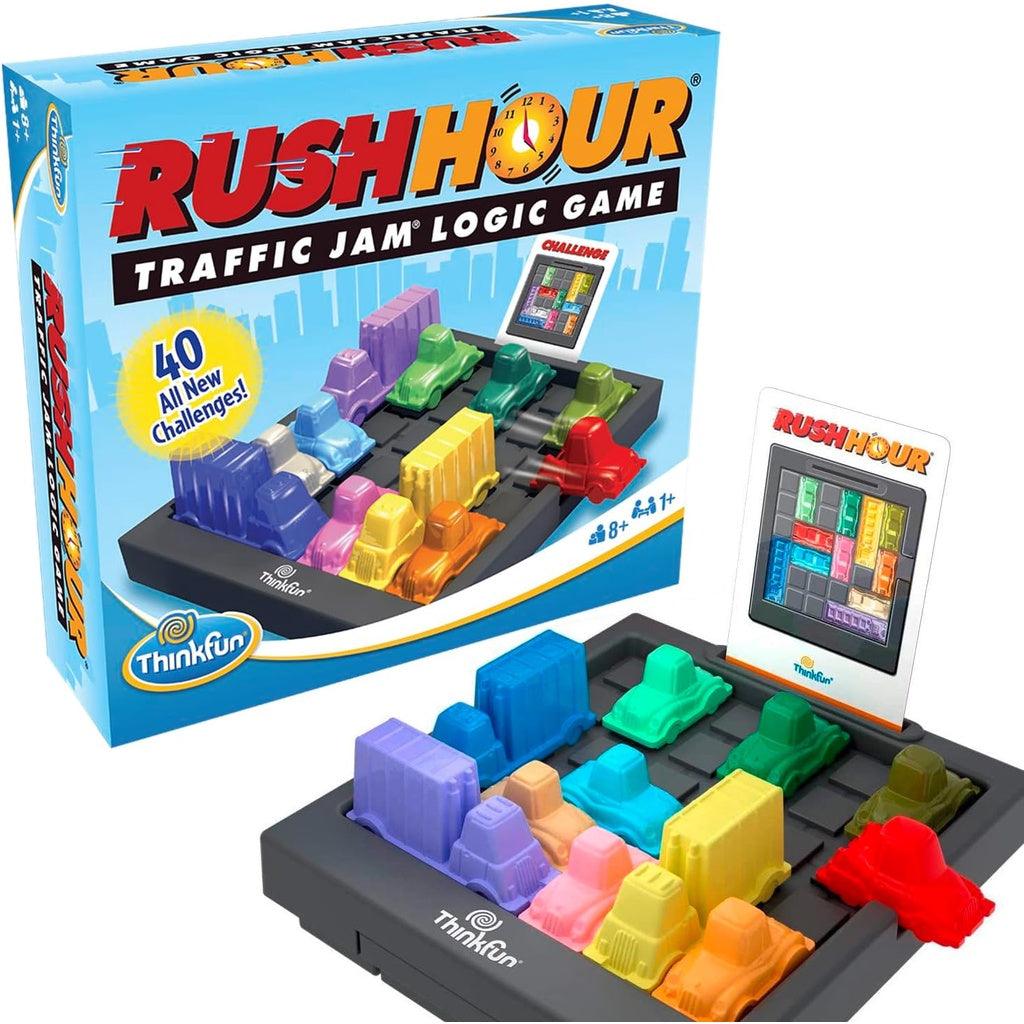
A few pieces are fine if they live inside a case. Tiny parts rolling under seats are not fine when you are three hours from home. Kanoodle works because the pieces return to the case. Rush Hour Junior works because the board contains the cars.
Quiet feedback
Road trips are already noisy. The best toys give feedback through movement, touch, challenge cards, colour, or visual progress instead of beeps and songs. If you pack an electronic toy for a sibling, check the volume before leaving.
Reset value
A road trip toy should be easy to restart after a gas stop, lunch break, ferry line, hotel check-in, or border wait. Puzzles with challenge cards, fidgets, drawing boards, and reusable sticker pads are stronger than one-and-done crafts.
Regulation support
Long drives are not just boring; they are physically demanding. Kids may need hand input, visual calming, or a small sense of control. If your child tends to pick, chew, kick seats, or ask for constant snacks, a tactile tool may matter as much as a puzzle.
Our Top 6 Picks
Pocket-size spatial reasoning puzzles
Pros
- ✓ Tiny footprint
- ✓ No setup beyond opening the case
- ✓ Many challenge levels
Cons
- ✗ Small pieces
- ✗ Mostly solo play
- ✗ Harder puzzles can frustrate
Kanoodle 3D is the strongest overall road-trip pick for many 8-year-olds because it feels grown-up without taking over the car. The case is small, the pieces are bright, and the challenges scale from quick wins to real spatial reasoning. It can fill ten quiet minutes at a restaurant or a longer stretch in the back seat.
The small pieces are the main caution. This is not a toy to hand over loose in a messy vehicle. Teach your child to open the case on a lap desk, book, or travel tray, and pause the puzzle before getting out at a stop. If your child throws pieces when frustrated, start with easier challenges and save the harder cards for hotel downtime.
ThinkFun Rush Hour Junior
Fast-start traffic-jam logic puzzles
Pros
- ✓ Very low setup
- ✓ Clear challenge cards
- ✓ Good early logic practice
Cons
- ✗ Single-player
- ✗ Can feel repetitive
- ✗ Limited collaborative play
Rush Hour Junior is a great fit for 8-year-olds who like visible logic. The goal is simple: slide the vehicles until the ice cream truck can escape. Because the board contains the pieces, it is more travel-friendly than many puzzle games. Challenge cards also make it easy to stop and restart.
For puzzle-loving 8-year-olds, Junior may eventually feel easy. That can actually be useful in the car, where the goal is quiet engagement rather than maximum difficulty. If your child wants a deeper logic comparison, Mental Blox vs Rush Hour Junior for Logic Skills goes further.
Silent tactile input on desks, notebooks, and devices
Pros
- ✓ Invisible in class
- ✓ No loose parts
- ✓ Great for quick regulation
Cons
- ✗ Adhesive wears over time
- ✗ Limited texture per strip
- ✗ Needs clean surfaces
Calm Strips are not a toy in the classic sense, but they can make a long drive easier. Put one on a water bottle, notebook, phone case, tablet case, clipboard, or the outside of a travel pouch. Your child gets a silent texture to rub when waiting, anxious, bored, or overstimulated.
Introduce the strip before the trip so it does not feel like a correction. Let your child choose the placement. If you are deciding between tactile options for school and travel, Calm Strips vs Marble Mesh Fidget for Classroom Focus can help.
Portable quiet play for travel and waiting rooms
Pros
- ✓ Very affordable
- ✓ Travel friendly
- ✓ Instant setup
Cons
- ✗ Sticker loss
- ✗ Shorter sessions
- ✗ Theme-limited
A reusable sticker pad can be too young for some 8-year-olds, but it is still useful in real family travel. It is flat, quiet, inexpensive, and easy to hand over during restaurant waits, hotel check-ins, ferry lineups, or the final twenty minutes before arrival. Some 8-year-olds use it to make scenes and stories rather than just place stickers.
The weakness is replay depth. It will not replace a true focus toy like Kanoodle or Rush Hour Junior. Pack it as a backup, especially if younger siblings can use it too. Keep it in a zipper pouch so the sticker sheets do not spread through the vehicle.
Liquid Motion Bubbler Timer
Visual calming during short reset breaks
Pros
- ✓ Quiet visual input
- ✓ Low setup
- ✓ Good calm-down corner fit
Cons
- ✗ Can leak if damaged
- ✗ Mostly passive
- ✗ Some kids lose interest quickly
A liquid motion timer is useful for short reset moments, not long entertainment. It can help during a break at a rest stop, while waiting for food, or when a child needs something quiet to watch before getting back in the car. For some kids, the slow visual movement is more calming than another game.
Check the timer before packing it. If it is cracked, sticky, or likely to be thrown around, leave it at home. It works best in a small calming pouch with a fidget and a snack plan, not loose under the seat.
Marble Mesh Fidget
Quiet hand movement and repetitive tactile regulation
Pros
- ✓ Very affordable
- ✓ Quiet
- ✓ Pocket friendly
Cons
- ✗ Can tear with rough use
- ✗ Less engaging for some younger kids
- ✗ Easy to misplace
A marble mesh fidget is one of the easiest road-trip add-ons. It is small, silent, cheap, and satisfying for repetitive hand movement. It can help an 8-year-old listen to music, watch scenery, or wait through traffic without clicking a noisy toy or poking a sibling.
It is not exciting enough to be the only activity. Buy it as a regulation support tool and consider packing two because small fidgets disappear easily. If your child needs more quiet focus supports beyond travel, see Alternatives to Noisy Fidget Toys for Classroom Focus.
How to Build a Better Road Trip Kit
Choose one main focus toy
For an 8-year-old, this is the item that should hold attention for a meaningful stretch. Kanoodle 3D and Rush Hour Junior are the strongest fits here because they are quiet, contained, and challenge-based.
Add one regulation tool
A fidget, Calm Strip, chew-safe option, or visual calming tool helps with the physical strain of travel. Do not expect it to entertain for an hour. Its job is to keep the body regulated enough that the rest of the trip goes better.
Add one creative backup
A drawing notebook, reusable sticker pad, low-mess travel clipboard, or simple writing prompt gives your child a different mode when they are done with puzzles. If your child dislikes crafts but still wants creative play, see Best Creative Toys for Kids Who Dislike Crafts.
Pack by pouch, not by giant bag
Use small zip pouches: one puzzle pouch, one fidget pouch, one creative pouch. Rotate them at stops instead of showing everything at once. Novelty lasts longer when the whole kit is not visible from the first kilometre.
Plan for the last stretch
The final part of the drive is often hardest. Save one fresh item, snack, audiobook chapter, or parent-led car game for that window. Do not spend the entire kit in the first hour.
Want better toy picks without the research rabbit hole?
Short, practical recommendations by age, need, and budget.
FAQ
What is the best road trip toy for an 8-year-old who gets bored quickly?
Choose a challenge toy with short rounds, like Kanoodle 3D or Rush Hour Junior, then rotate it with a tactile fidget and a creative backup. Short repeated sessions usually work better than expecting one toy to carry the whole drive.
What should I avoid packing?
Avoid slime, loose beads, loud electronic toys, messy markers, fragile kits, and anything with important tiny pieces that can disappear under the seat. Save big construction toys for the destination.
Are fidgets enough for a road trip?
Usually no. Fidgets help with restlessness and regulation, but they are not a full boredom plan. Pair a fidget with a puzzle, book, drawing option, or audiobook.
How many toys should we bring?
For a day drive, three to five small items is usually enough: one thinking toy, one fidget, one creative backup, and one extra item for waits. More toys often create more mess without improving the trip.
Related reads
- Best Travel Sensory Toys for Road Trips with Kids
- Best Toys for Long Car Rides
- Best Travel Toys for Airplanes with Kids
- Best Toys for Kids Who Get Bored Easily
- Best Gifts for Kids Under $25
If You Can Only Buy One
Educational Insights Kanoodle 3D is the safest single pick for most 8-year-olds because it is small, quiet, self-contained, and challenging enough to feel like an older-kid activity. If your child gets frustrated by spatial puzzles, choose Rush Hour Junior for clearer visual logic or a tactile fidget plus drawing kit for a lower-pressure drive.
Want better toy picks without the research rabbit hole?
Get concise recommendations by age, need, and budget.
Where to go next
By age
Best Homework Break Toys for 8-Year-Olds
Keep the recommendations age-appropriate for your kid’s stage.
By need
Gifts for Neurodivergent Kids: A Parent's Guide (2026)
Jump to picks focused on ADHD, sensory, and regulation support.
By budget
Best Gifts for Kids Under $25 (2026)
Compare strong options in lower price brackets before you buy.
Related Articles

Mental Blox vs Rush Hour Junior for Logic Skills
Compare two low-tech logic toys for kids who need more thinking reps without screens.
Read more →
Monster Scale vs Numberblocks MathLink Cubes for Preschool Math
Compare two hands-on math toys for early counting, number sense, and quiet learning play.
Read more →
Best Calm Waiting-Room Toys for Kids
Small quiet toys for appointments, restaurants, waiting rooms, and other moments where kids need help staying regulated.
Read more →